meet irvin

Two devices.
One full diagnosis.
Zero guesswork.

Irvin monitors the outdoor condenser and the indoor air handler of any split system you service by using two separate easy-to-install devices that seamlessly communicate with each other. Irvin gathers data an HVAC tech looks for to diagnose a unit 24/7 and immediately detects issues as they occur. When a component is degrading or failing, Irvin knows what and where before the call comes in.

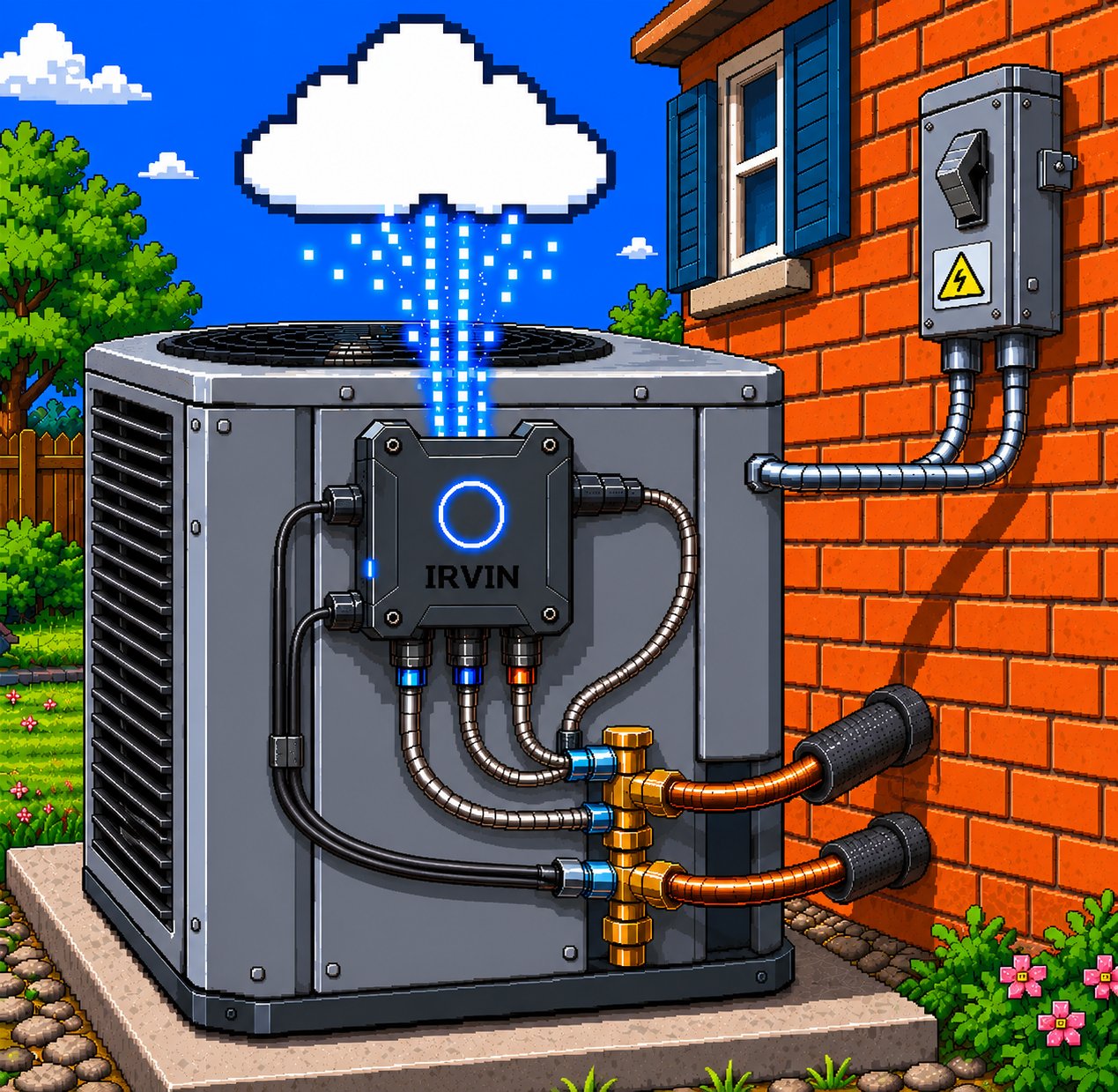
Irvin clipped onto the outdoor condenser unit.
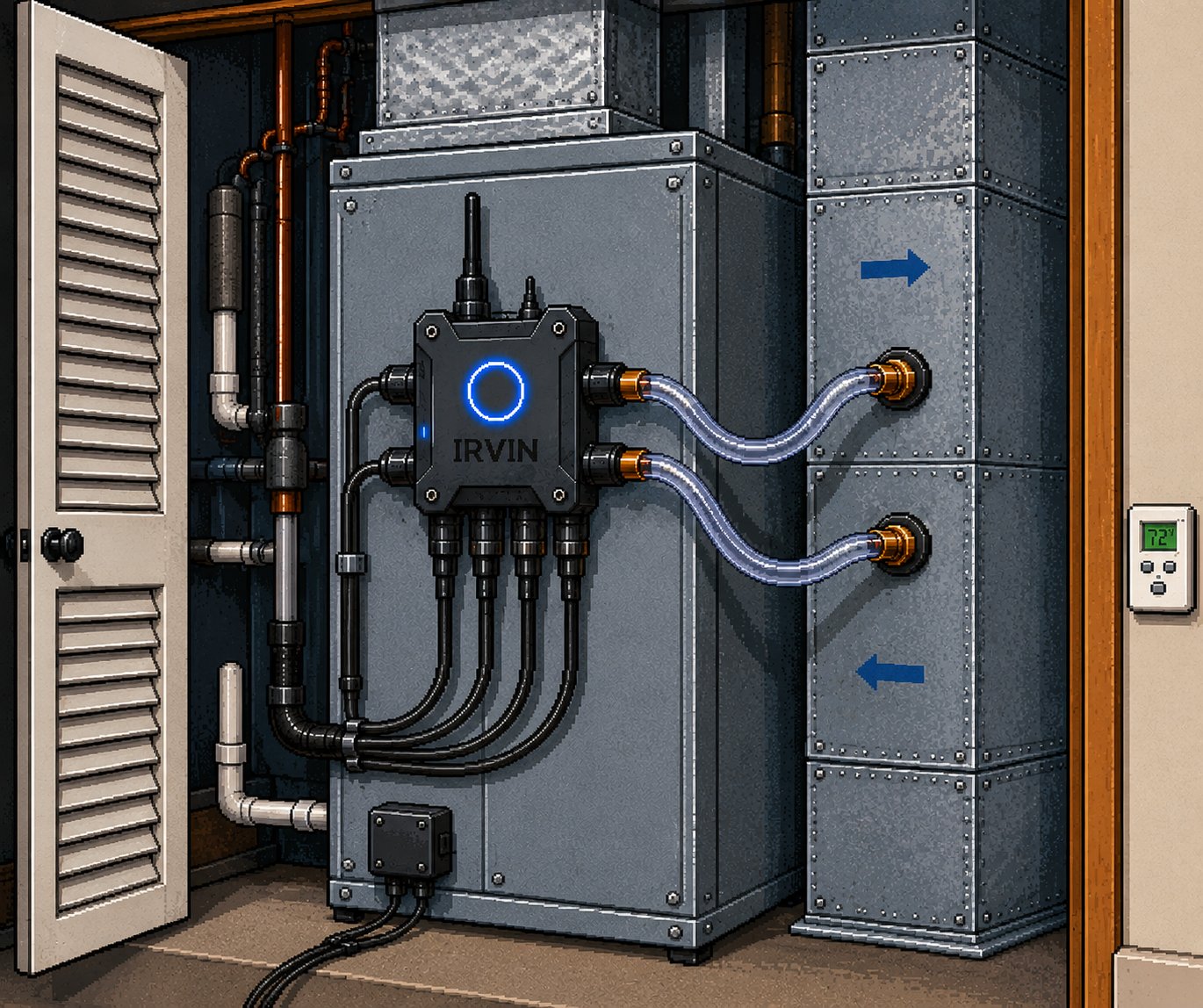
Irvin clipped onto the indoor evaporator and air handler.
device 01 · outdoor

Monitoring the condenser.

Mounted at the outdoor condenser. Reads refrigerant pressure on both sides of the cycle, line temperatures for sub-cool and super-heat math, and the compressor's electrical signature, plus vibration and running sound from the fan and compressor. Talks to the indoor device over Sub-GHz so no extra wiring runs between the two units.

Irvin clipped onto the outdoor condenser unit.
01 HIGH-PRESSURE TRANSDUCERS

Reads pressure on both sides of the cycle.

Two industrial-grade high-pressure transducers. One on the liquid line, one on the suction line. This is the same data a tech reads off a gauge set, but continuously instead of once per service visit.

Combined with: the line-temperature probes below, this is how Irvin calculates sub-cooling and super-heat in real time.
02 LINE TEMPERATURE PROBES

Catches charge issues weeks before they bite.

Surface temperature probes strapped to the suction and liquid lines. Together with the pressure data above, Irvin computes sub-cool and super-heat live, so undercharge, overcharge, and slow leaks show up as drift instead of as a "no cool" callout.

03 CURRENT + VOLTAGE SENSORS

Hears the compressor before it screams.

Clamps on the dual hermetic / fan capacitor and on system mains. Reads current draw waveform, voltage, and start behavior. Identifies hard-starts, capacitor drift, and motor degradation that precedes catastrophic compressor failure by weeks or months.

Why this matters: a capacitor swap on a routine visit is <$25 in parts. A compressor replacement after that capacitor finally goes is $2,000+ in parts plus a same-day truck roll.
04 SUB-GHZ RADIO

Talks to the indoor device through walls and concrete.

Sub-GHz penetrates structure better than WiFi (2.4 GHz), so the outdoor and indoor devices stay paired across crawlspaces, mechanical rooms, and basement air handlers without running new low-voltage between the two units.

05 MAINS POWER + BACKUP BATTERY

Reports through the outage too.

Pulls power from the condenser's own supply during normal operation. Onboard battery keeps Irvin reporting through brownouts, breaker trips, and storm-driven outages, which is exactly when techs need diagnostic data most.

06 VIBRATION ACCELEROMETER

Feels the fan and compressor before they fail.

A MEMS accelerometer reads the mechanical signature of the condenser fan motor and compressor. Bearing wear, imbalance, and mounting fatigue show up as vibration drift long before they are audible to a tech, so a worn bearing becomes a planned part swap instead of a seized motor and a dead unit on the hottest day of the year.

07 ACOUSTIC MICROPHONE

Hears the small sounds that come before a breakdown.

An onboard microphone listens for the subtle shifts in running sound that precede failure: compressor knock, valve chatter, a fan starting to rub. On its own a sound is just a sound. Combined with Irvin's pressure, temperature, current, and vibration data, it becomes another early signal of declining unit health.

device 02 · indoor

Monitoring the air handler.

Mounted at the indoor air handler. Watches airflow, return and supply temperatures, the evaporator coil, the condensate drain, and the indoor electrical side, plus blower vibration and running sound. Also handles the uplink to Phase Sight (WiFi, with an optional cellular hub for sites where WiFi is weak or unavailable).

Irvin clipped onto the indoor evaporator and air handler.
01 DIFFERENTIAL PRESSURE TRANSDUCER

Measures airflow directly. No guessing.

Connects across the return and supply sides of the air handler. Reads static pressure differential, which is how Irvin tells the difference between a dirty filter, a blocked coil, a kinked duct, and a degraded blower motor (symptoms that look identical at the thermostat).

02 RETURN + SUPPLY TEMP PROBES

Wet-bulb on return, dry-bulb on both sides.

Three probes total. Return-side wet-bulb plus dry-bulb gives Irvin the latent vs. sensible split, so it can spot humidity issues separately from cooling capacity issues. Supply-side dry-bulb closes the loop on coil temperature differential.

03 EVAPORATOR COIL TEMPERATURE

Distinguishes the two ways a coil freezes.

Direct read on coil temperature. Combined with airflow data and refrigerant charge from the outdoor device, Irvin separates "low refrigerant" freezes from "low airflow" freezes. The fixes are completely different, and getting the wrong one wastes a truck roll.

04 FLOAT SWITCH (CONDENSATE)

Catches drain backup before the ceiling does.

Two layers of drain monitoring. Irvin measures how long the drain takes to clear during operation and trends that over weeks, so a developing slowdown gets flagged before any back-up actually forms. If one does, the float switch fires an immediate alert with the unit address. The drain-clear visit happens before the tenant calls about a water stain in the ceiling.

Cost saved: a $0–$100 drain-clear vs. $2,000–$10,000 in ceiling, drywall, and flooring repair after an overflow.
05 CURRENT + VOLTAGE SENSORS

Catches electrical-related issues while the part still costs $20 to swap.

Three measurement points: the PSC blower capacitor, the mains supply into the air handler, and the 24V control transformer. Same job as the outdoor device: catch electrical degradation while the part still costs $20 to swap.

06 SUB-GHZ + WIFI + OPTIONAL LTE-M

Three radios. One uplink. Always reachable.

Sub-GHz talks to the outdoor device. WiFi uplinks to the building network and out to Phase Sight. For sites with weak or no WiFi (basement mechanical rooms, older buildings, rural properties), an optional LTE-M cellular hub plugs in and takes over the uplink.

07 MAINS POWER + BACKUP BATTERY

Stays online when the building doesn't.

Same setup as the outdoor device. System-fed during normal operation, onboard battery rides through outages. Buffered data lands the moment uplink returns, so techs see exactly what failed and exactly when.

08 VIBRATION ACCELEROMETER

Watches the blower motor bearings wear.

A MEMS accelerometer on the air handler reads mechanical movement from the blower assembly. Blower motor bearing wear, wheel imbalance, and loose mounts show up as vibration drift weeks before the noise reaches a resident, turning a seized blower (and a no-airflow callout) into a scheduled bearing or motor swap.

09 ACOUSTIC MICROPHONE

Listens for the sounds of a unit going downhill.

An onboard microphone picks up the small changes in running sound that signal trouble: a rattling blower wheel, a buzzing transformer, air whistling past a clogging filter. Layered onto Irvin's airflow, temperature, and vibration data, sound becomes one more way to read unit health before a resident files a complaint.

what it tells you

What Irvin actually diagnoses.

Sensors are inputs. These are the outputs. Every system you service, continuously, surfaced in the Phase Sight App and Dashboard the moment something starts to drift.

P

Refrigerant charge

Sub-cool and super-heat computed live from the pressure transducers and line-temp probes. Undercharge, overcharge, and slow leaks all surface as drift.

E

Compressor health

Current waveform, voltage, and start behavior. Catches hard-starts, lock-rotor risk, and slow degradation weeks before failure.

E

Electrical

Checks every electrical system and component on the unit (capacitors, contactors, transformers, control wiring, mains supply) for failure signatures and anomalies. Catches drift weeks before any single part actually fails.

A

Airflow restriction

Static pressure across the coil flags loaded filters, dirty coils, kinked ducts, and degraded blower motors. No guesswork required.

F

Coil freeze

Coil temp plus airflow plus refrigerant charge tells Irvin which freeze it is (low charge vs. low airflow) and which fix to dispatch.

D

Drain blockage

Float switch trips fire an immediate alert. Drain-clear visit goes out before water damage starts, not after.

V

Power quality

Voltage sags, brownouts, and phase issues on the supply side. Separates "system problem" from "building problem" before truck rolls.

Σ

Performance baseline

Each system's own running history. New anomalies stand out against that unit's normal, not against a generic spec sheet.

η

Efficiency drift

Tracks the system's real-world EER over months and years. Every percent of efficiency loss surfaces as a measurable cost increase, giving you the data trail to back a replacement recommendation instead of pitching it on intuition.

for the contractor

Replace the "trust me" pitch with the data trail.

Irvin's diagnostic data doesn't just help techs fix systems faster. It changes the business you can run. Six ways monitored service pays off, with real industry stats behind every number.

TRUST + DATA

Justify big-ticket replacements with data.

Stop pitching $3,500 compressor swaps on intuition. Show the customer 6 months of capacitor drift, charge drop, and current climb. The replacement becomes obvious, not pushy.

40-50% without Irvin
80-90% with Irvin

close rate on data-backed quotes

TRUCK ROLL EFFICIENCY

Cut return trips in half.

Techs roll up knowing the diagnosis, the part, and the time the job needs. First-time fix rate climbs and you stop eating the cost of the second visit.

58% without Irvin
87% with Irvin

first-time fix rate · ~$340 saved per return trip

EMERGENCY → SCHEDULED

Convert emergencies into scheduled work.

Irvin catches the developing failure weeks before the no-cool panic. The repair lands on a Tuesday morning maintenance visit instead of a Friday night truck roll.

$1,800 without Irvin
~$700 with Irvin

avg cost per call · 41% fewer emergency dispatches

EQUIPMENT LIFESPAN

Stretch compressor life by 4-6 years.

Capacitor drift, low charge, and electrical degradation are what kill compressors. Irvin flags every one of them weeks ahead, so the small fix happens before the cascade.

10-12 yr without Irvin
14-18 yr with Irvin

avg compressor lifespan · ~$4,200 saved per prevented cascade

RECURRING REVENUE

Build the maintenance plan your bank likes.

Monitored service contracts smooth out shoulder-season cash flow, give you something tangible to upsell on, and turn one-off customers into multi-year revenue streams.

baseline without Irvin
+20-40% with Irvin

annual revenue per customer on service agreements

PREMIUM PRICING + RETENTION

Charge more for monitored service.

IoT-monitored maintenance tiers command higher pricing than standard, and customers stick around longer because they actually feel the value.

78% without Irvin
94% with Irvin

contract renewal rate · +12-18% premium pricing

how data flows

From the system to Phase Sight.

The indoor device handles the uplink. WiFi covers most sites. For mechanical rooms, basements, and properties with weak or no WiFi, an optional cellular hub plugs in and takes over.

SENSORS
IRVIN
WIFI or LTE-M
PHASE SIGHT CLOUD
PHASE SIGHT APP & DASHBOARD
PRIMARY UPLINK

WiFi

The indoor device joins the building's WiFi network during install. From there, Irvin streams telemetry continuously to Phase Sight, which feeds the Phase Sight App and Dashboard you and your team work out of.

  • Works on any standard 2.4 GHz WiFi
  • Minimal bandwidth (telemetry, not video)
  • Auto-reconnects after outages, buffers data locally
OPTIONAL FALLBACK

LTE-M cellular hub

For sites with weak or no WiFi (basement mechanical rooms, older buildings, rural multifamily), the cellular hub plugs into power and takes over the uplink. Irvin devices auto-route to it instead of WiFi.

  • One hub covers all systems at the site
  • LTE-M is the low-bandwidth IoT carrier band
  • Drop-in install, no IT involvement needed
compatibility

What Irvin works on.

If the system has a separate outdoor unit and indoor unit with a refrigerant line set between them, Irvin clips on.

System type Supported Notes
Residential central air (split A/C) Yes The bread-and-butter use case. Standard 30-minute retrofit.
Light commercial split A/C Yes Same install pattern. Works on most rooftop-mounted condensers and indoor air handlers.
Mini-splits / ductless Yes Indoor device mounts at the wall head or cassette. Differential pressure measurement is adapted for ductless airflow.
Heat pumps Yes Same sensor layout as A/C. Adds heating-mode diagnostics (reversing valve, defrost cycle health).
Packaged rooftop units (RTU) No Single-cabinet, no split. Not on the current roadmap.
VRF / VRV systems No Multi-zone refrigerant routing is out of scope for this generation.
Chillers / boiler-fed systems No Different working fluid and architecture. Not a fit.
install

Certified HVAC technicians can install Irvin in ~30 minutes.

No special truck rolls, no separate tenant access window. Your existing HVAC contractor (or ours) installs both Irvin devices during a routine maintenance visit on the system.

⏱ ~30 MIN · BOTH UNITS TOGETHER
STEP 01

Mount the outdoor device

Strap pressure transducers and temperature probes on the liquid and suction lines at the condenser. Wire the current and voltage sensors at the disconnect. Connect to system power.

~12 min
STEP 02

Mount the indoor device

Install the differential pressure transducer across the air handler. Place return and supply temp probes and the coil sensor. Tie in the float switch and electrical sensors. Connect to system power.

~15 min
STEP 03

Pair and connect

Devices auto-pair over Sub-GHz on power-up. Indoor device joins WiFi (or the LTE-M hub if needed). Irvin starts reporting in the dispatcher app within a few minutes.

~3 min

Get Irvin on every system you service.

Pre-order now to lock in the early-customer price. Hardware ships first, Phase Sight App subscription details announced ahead of ship date.